
Chapter 9: Rabbit Pose
Full Flexion of the Spine

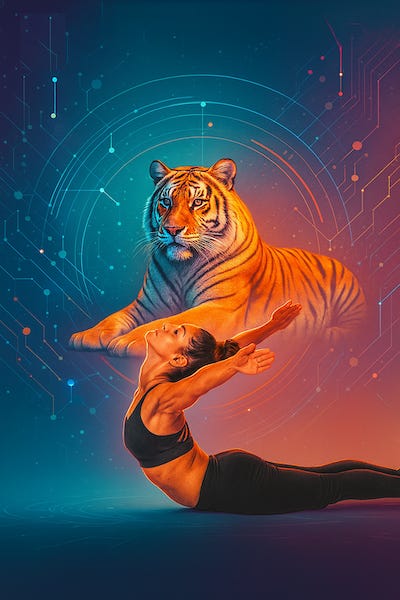
The Tortoise, the Hare, and the Curved Bridge
The yoga sequence gives us both a tortoise and a rabbit.
Half Tortoise mirrors the animal that wins Aesop’s fable — steady, patient, retreating into its shell for protection. Rabbit takes the other role: quick, compressed, coiled with potential energy. The story usually pits them against each other. Slow and steady versus fast and reckless.
But in your body, you need both.
Half Tortoise is the long game. Arms stretch forward, spine lengthens, breath deepens. It teaches endurance in stillness, parasympathetic downshift, a shell of safety formed by diaphragmatic breathing and axial extension.
Rabbit, by contrast, is the spring. Curling the spine into global flexion, the posture compresses intervertebral discs like sponges, pushing out fluid to be reabsorbed on release. Fascia and ligaments store elastic energy like a drawn bow. Inversion shifts pressure in the venous and lymphatic systems, while the dome-like rounding shields the heart and viscera.
The tortoise teaches withdrawal as endurance. The rabbit teaches withdrawal as readiness. One sustains. The other recoils.
Together, they show that inward retreat isn’t collapse. It’s strategy.
In Rabbit Pose, the key is marrying the tortoise’s steadiness with the hare’s spring — creating a spine that’s protective, resilient, and primed for powerful release. Like a crouching tiger: calm on the surface, coiled with hidden power, waiting for the strike.